
|
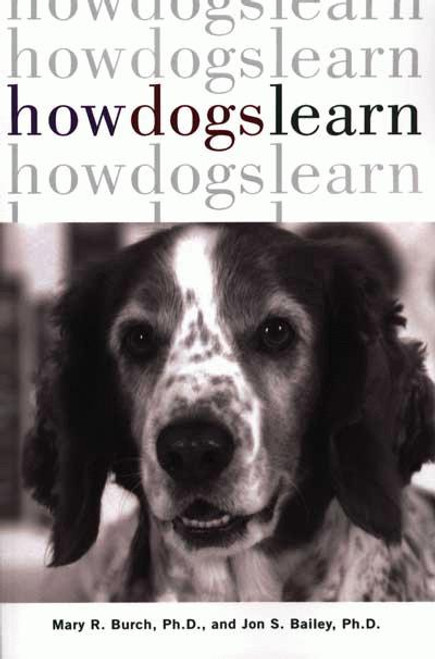
HOW DOGS LEARN
by Mary Burch & Jon Bailey (See other books by author)
|
|
Publisher: Howell Book House
Edition: 1999 Hardback, 224 pages
ISBN: 0876053711 Item: DTB619
Ships the next business day.
Summary: Operant conditioning is where science and dog training meet. This book explains every scientific concept clearly and precisely, with its relevance to your dog. Includes a history of animal training, basic principles, behavioral diagnostics, more.
| Price: $19.95 |
|
|
|
Expanded Description:
Explains the science of operant conditioning, the psychological principle upon which almost all animal training is based. Operant conditioning is the place where science and dog training meet, and the authors bring you there in terms anyone can easily grasp. Every scientific concept is explained clearly and precisely, and its relevance to your dog is laid out. Includes a history of animal training, the basic principles of behavior, behavioral diagnostics (why does the dog do that?), increasing behaviors (teaching your old dog new tricks), decreasing behaviors (dealing with canine delinquents), differential reinforcement, antecedent control, and using punishment. A must-have book for the more serious dog person or behaviorist.
|
|
Dig In
| Back Cover
|
TOC Page 1
|
TOC Page 2
|
See all 7 Pages.
|
|
| Dogwise Thinks You Might Enjoy:
|
|
Customers who bought this product
also bought:
|
|
| Customer Reviews |
| Average Customer Ranking: |
 |
| Write a review for this product! |
| |
 |
| science behind training, August 7, 2008 |
| Reviewer: Stephanie Wesloh |
| This book is quite useful for understanding the science behind the art of dog training. The average dog owner may not have enough interest to read this book, but dog trainers should find it valuable. This seems to be the most referenced book on the science of dog training. Not a dog training book, per se, but information on how dogs learn. Explains the various types of reinforcement and punishment and how they affect learning in dogs. Don't read this book to learn how to train your dog, read it to learn how to understand training and to be a better trainer. |
| |
 |
| Great Reading & Excellent Reference Book, January 14, 2007 |
| Reviewer: Sue |
| I started this book by reading the foreward by Jack Michael Ph.D., Department of Psychology, Western Michigan University. I wondered what I had gotten myself into and if I would like the book or would it be too technical for me. Jack Michael aptly describes this book with his last sentence, 'If I had to characterize this book with a single sentence, I would say that it is practically very useful without sacrificing scientific and technical accuracy.' This book clearly explains operant conditioning. In 10 years of obedience training classes, I have been taught many of these techniques, but no one ever gave me the names of what I was doing. No one ever told me how important my timing is. Even though I, of course, knew dogs didn't understand words, I did not know that I was CONDITIONING them to my commands and that praise works best when first conditioned with primary reinforcers, such as food. This book expanded my world and enhanced life with my beloved Alaskan Malamutes. Some readers may find that this book is too technical and lacks the story telling quality of some of the best sellers, but if you want to know what you are doing, why you are doing it and why it is so important to train correctly and consistently, you will want to read this book. You'll keep it available as a reference for situations that may come up as you raise and train your dog. I highly recommend this book! |
| |
 |
| A must have reference, March 22, 2006 |
| Reviewer: Erich Tilgner |
| I just got a copy of this book and I am very pleased with it. I have already read many books on the subject, but this book is a welcome addition because it provides a nice overview and clearly referenced discussion of the topics of dog training and the evaluation behavior problems. The charts and tables provide useful information and clear ways of viewing issues you face when training. The outline of dog training and behaviorism history is unique. This book is a nice compliment to the Ramirez training 'bible' and books like the culture clash, excel-rated learning, etc. |
| |