

Think Defensive Not Aggressive
For decades, the word “aggressive” has been used to describe dogs who growl, snarl, snap, or bite. But that label carries heavy baggage: moral judgment, assumptions of malice, and a belief that confrontation is the only answer.
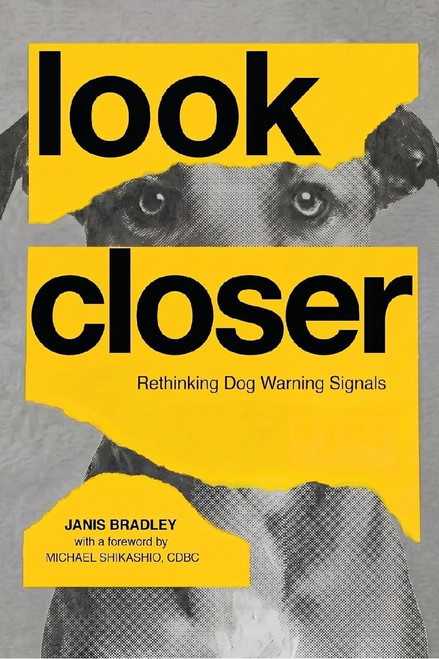
In Look Closer, science writer Janis Bradley invites readers to reconsider what dogs are actually communicating in these moments. Drawing on behavioral science, canine genetics, shelter research, and decades of real-world observation, she shows that most warning and biting behaviors are best understood not as attempts to do harm, but as defensive responses to perceived threats.
Changing that single word changes everything.
When we replace judgment with understanding, we make better decisions—about safety, about intervention, and about the dogs we share our lives with. From family homes to shelters to public policy, this shift in perspective opens the door to more effective responses, greater empathy, and stronger human–canine bonds.
Written for both dog professionals and dog guardians, Look Closer is not a training manual, but a guide to seeing dogs more clearly—and responding in ways that help everyone feel safer.
Praise for Look Closer
Look Closer is thoughtful, rigorous, and humane. Bradley is compassionate and willing to challenge ideas that have become so familiar that we sometimes stop examining them.
The central premise that the words we use shape not only how we think about dogs, but ultimately how we treat them lands deeply. Reframing “aggressive” as “defensive” is so much more than a vocabulary change; it opens the door to curiosity and empathy rather than judgment. I found myself thinking again and again about how powerfully that applies in my own work with separation anxiety.
Look Closer recasts warning signals as peacekeeping communication rather than evidence of a defective or dangerous dog. The “please don’t make me bite you” framing is so simple and so profound, and the point that warning signals are about keeping the peace, not disrupting it, is one I wish every dog guardian and professional could absorb.
The chapters about dogs living in shelters are really meaningful. “Dogs between homes” is a humane and accurate shift, and the examination of how readily we can pathologize normal behavior is so good and very important.
Beyond the ideas themselves, I love the balance of science, storytelling, humor, and personal reflection. The book is tremendously well researched, but it never feels inaccessible. It feels like an invitation to think more carefully, and more kindly.
This is an important and wonderful book, and I am so glad it is in the world. Malena DeMartini-Price, CTC, CDBC, author of Separation anxiety in dogs: Next generation treatment protocols and practices Treatment of separation anxiety in dogs
Ever wonder what your dog is really saying when she barks, growls, or gives you that hard stare? Look Closer by Janis Bradley flips the script on canine aggression, revealing how a simple shift in language—from ‘aggressive’ to ‘defensive’—can unlock empathy, dissolve stereotypes, and help us build safer, happier bonds with our four-legged friends. Packed with science, stories, and a dash of wit, this book is your invitation to see dogs and what they are communicating to us in a whole new light. Steve Dale, CABC; editor Ask the Dog; program host WGN radio; blog, www.stevedale.tv
In a field where everyone is trying to be kind, I have come to believe that kindness itself sometimes fails dogs. We turn them into diagnoses, we let labels stand in for explanations and call it science, and through a closer look, you lift the lid on that science, find the fluff, and replace it with the real thing. What I love most is that you do not accept the obvious. You question it, gently and eloquently, and you insist on the honesty our field so often skips: that folklore is not fact, and that we should not claim evidence we do not have. Reading Look Closer reminded me there is a difference between being kind and doing kind, between being compassionate and doing compassion, and you do not just describe that difference. You are it. You do it all through the dogs you have loved, so it never once reads as a lecture, and it gave me room to laugh, to well up, and to feel grateful in a single read. Thank you, Janis, for reminding me to see the dog and not the diagnosis, and for showing that a scientific eye does not cool our compassion, it sharpens it.
Chirag Patel, c(Hons), CPDT-KA, DipCABT
Janis Bradley is a science writer specializing in canine behavior and the human-canine bond. She has co-authored peer-reviewed research on canine behavior and is the author of Dogs Bite, but Balloons and Slippers Are More Dangerous.